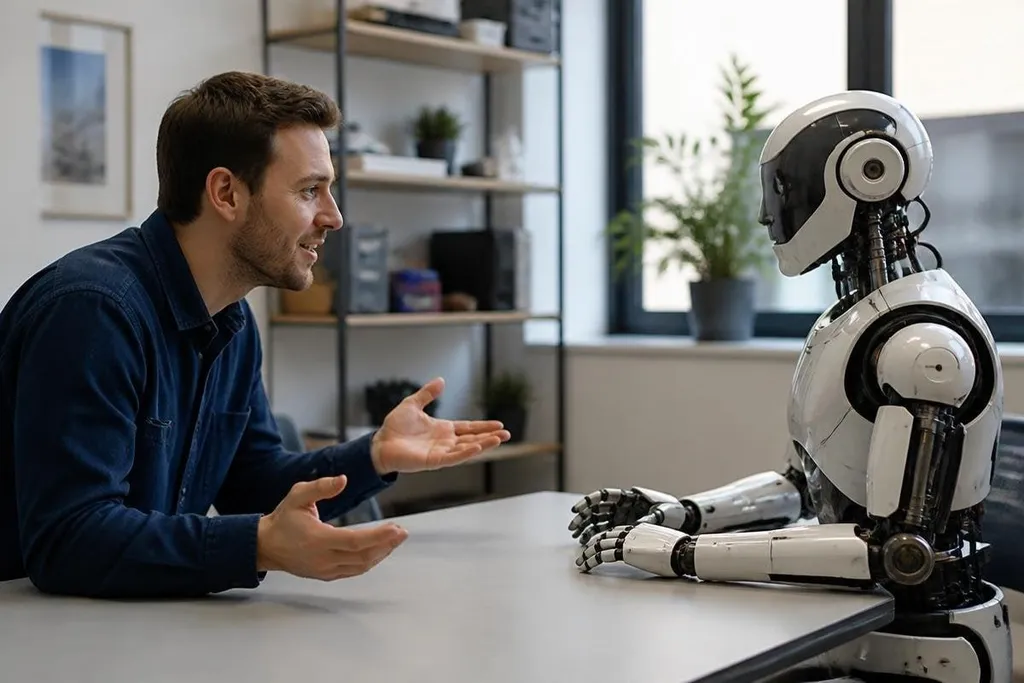
A robot can spot a joke in text, yet that does not mean it understands why people laugh. The hard part is reading tone, shared knowledge, timing, and the reason someone chose those words.
- Humor may depend on voice, facial movement, timing, or earlier conversation.
- A language model can find patterns in jokes without having a social point of view.
- Safe robot behavior needs a clear response when the joke is unclear.
What a robot has to read
Humor starts with signals that can arrive through several channels. A robot may receive words from a language model, sound from a microphone, and visual information from cameras. Each source adds context, but each can also leave something out.
A sentence can sound friendly in one voice and rude in another. A pause before the last word can change a line from a statement into a joke. A face, gesture, or shared event can tell people how to read the same sentence, while a text-only system sees the words without those clues.
The timing matters too. A person may pause because they are thinking, not because they are setting up a punchline. A robot that reacts to every pause as a joke will interrupt normal conversation. That failure is easy to spot in a home, shop, or care setting.
Pattern matching is not social understanding
Language models can learn common joke structures from large collections of text. They can identify wordplay, an unexpected ending, or a mismatch between a sentence and its context. That gives the robot a useful starting point.
The missing part is the reason behind the joke. People use humor to build trust, soften a request, test a relationship, or point out a problem. The same words can help one person and offend another, depending on their history and the setting.
A model may label a sentence as humorous because similar wording appeared in joke data. It still may not know whether saying that sentence to a customer, child, patient, or colleague is suitable. Classification can produce a label; it does not settle the social choice that follows.
This is why a robot needs more than a humor score. It needs the speaker, listener, setting, recent conversation, and a way to express uncertainty when those details are missing.
Where the error matters
A missed joke can make a robot sound stiff. A wrong joke can do more damage, especially when the robot has authority, handles private information, or works near people who cannot easily leave the interaction.
For a warehouse robot, humor may have little value during a safety alert. A short warning should remain clear when a person is tired, distracted, or working beside moving equipment. In a home robot, playful speech may be useful, but the system still needs to separate play from an instruction about medication, heat, or a blocked path.
That leaves humor with a narrow job: it can shape a social exchange, but it should never blur an instruction tied to safety or care. Robot24.com’s robotics coverage can place claims about robot humor beside the machine, setting, and task being tested.
The safest response is often a plain one. If the system cannot tell whether a person is joking, it can ask for clarification, acknowledge the comment without copying it, or return to the task. That may sound less natural, but it reduces the chance of a social error.
What would count as real progress
A useful test would measure more than whether a robot labels jokes correctly. It would check whether the robot responds in a suitable way across changes in voice, timing, background noise, speaker relationship, and task risk.
The test should also include cases where no joke is present. A system that calls every unusual sentence humorous has learned a shortcut, not the situation. Human reviewers would need to judge both the label and the robot’s next action.
I’d judge a robot by its restraint before its wit. A machine that knows when to stay quiet is closer to useful social behavior than one that produces a clever line on demand.
A practical check before deployment
Use this short guide when a robot will speak with people:
- Name the setting: Decide where humor is allowed and where clear speech must take priority.
- Check the inputs: Record whether the system receives text, audio, video, or only one of these signals.
- Test missing context: Remove the earlier conversation and see whether the response changes safely.
- Measure refusal behavior: Give the robot unclear or risky comments and check whether it asks, pauses, or changes the subject.
- Review the audience: Test speech with the people who will actually hear it, not only with engineers.
- Keep a plain mode: Give operators a setting that removes jokes from alerts and task instructions.
Humor in robots will improve when systems can connect language with context and risk, not when they produce more jokes. The open question is whether a machine can learn when a human wants laughter, comfort, criticism, or no response at all.